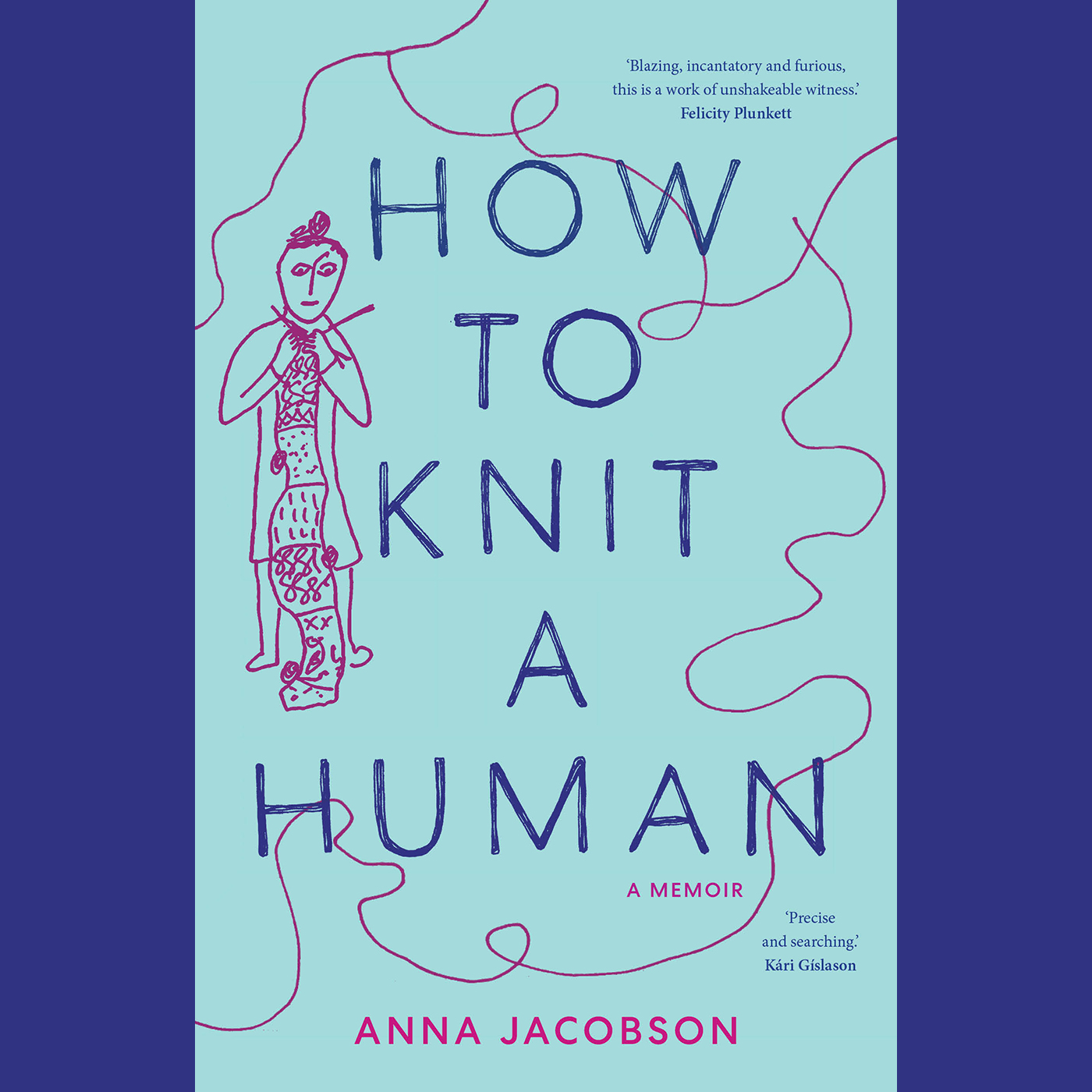
Settling on a structure in a longform nonlinear work is something I find tricky. My memoir, How to Knit a Human, which explores the impact of a two-month involuntary hospitalisation on my life, and my memory in particular, uses an experimental braided structure. Working out the order and weaving was a process that took most of the three years of my doctorate in creative writing.
There is no one right way to structure a work. You’ve got to start the story somewhere, so you may as well choose the place that keeps drawing you back. For me, this start was waking up in hospital in 2011, after a round of unconsented electroconvulsive therapy (ECT) for a mental health condition, with no memories or sense of self and having to piece my life back together like a detective. I was twenty-three at the time and my universe as I knew it had split into ‘before’ and ‘after’ this moment.
Lying down, she recognises a hospital bracelet with her name. Anna. Nothing attaches itself to the letters. No memories of who she was or might be now. She knows her self from ‘before’ would be worried by this, but can only feel acceptance.
Nearly a decade on, I was lucky to have incredible PhD supervisors. When I was having difficulties with the many ways to piece myself back together through writing, my principal supervisor suggested to think of the structure as a shape or a line to see where the key scenes rose and fell, like breath itself.
I thought of three shapes. At first, I thought of a branch, with past and present leaves branching off – either chronologically or as the memories emerged. Then I pictured a wave, washing from present to past to present to past. But the form that resonated most, and which I ended up choosing was a braid, because then I could have one strand for each of my three ‘timeline’ selves woven into one whole.
To delineate between my selves, I had named them: Before, After and Cardea. Cardea – a Roman and Greek Goddess of the Hinge – is my unravelling and memory-loss self, an earlier and split version of me. I wrote Cardea’s sections in the third person because I felt distanced from this self.
Writing is when I can often find many of my selves and listen to the different parts of me who want to highlight different aspects of my life. By communicating on the page, I can come to more of a consensus about what the work wants to be. But this process takes time and many revisions as the different parts come to an agreement and compromise.
I feel like I went through hundreds of versions of possibilities of structure and in the end, the published version is just one way of how it settled. Each version is a time portal of where I was at during the time of writing. For example, many more years ago, when I first tried to write my story, my writing was more linear. With time and distance, this timeline is now its own important strand in the nonlinear braid. The form of the braid finally matched the memoir’s narrative where I am trying to piece the memories and selves together.
Once I visualised the structure of my memoir to determine what the core metaphor of the story was about, I could ‘see’ the form I wanted. Once I had this form, I could pull the threads together.
Even though I could now visualise the form I wanted, I still struggled to hold all the pieces at once. I even referenced this process in the very first page of my memoir:
Understand the making of your memoir is a ritual: join and piece your story together – try many times, in different selves, patterns.
At least I always knew how I wanted my story to open: that first awakening in hospital in 2011 with no memories of self. But how to hold all the other scenes in my memory at once, so I could move them around and see what order worked?
At my supervisor’s suggestion, I created coloured blocks in a spreadsheet for each scene. This was after I had already written many of the scenes. I moved them around to track where they went. I am very visual and mapping it out in this way helped me – a different colour for each of the three timelines and selves. The transitions between scenes were the hardest for me. Once the structure had been woven, I worked hard on smoothing the joins between vignettes with signposts and transitions, so the reader could see the connections.
By mapping it all out, I also saw that in the early part of the memoir drafting I was changing too quickly between scenes and spending barely a page on each timeline. So I rearranged some of the scenes again and expanded on certain sections. For example, on an earlier draft, I spent one page on my ‘awakening’ in hospital and then launched into a scene about getting my first camera at age sixteen. In the later version, I moved this scene with the camera so that it doesn’t occur until twenty pages on. This way, more is spent with the hospital scenes and the bits from this time that I could remember, despite the memory loss. I also included a memory from when I was five of looking through a video camera for the first time. This was to create scaffolding, and more understanding of why my first camera was so important to me. One reworked transition that links between different timelines reads as following:
The night I looked through Uncle Emil’s video camera on Yom Kippur was the beginning. That night I would discover the world could exist as two ways of seeing. I could experience the world as it was happening, and I could also capture it for later. But I am yet to realise there is also a third way of seeing, and that to glimpse such a thing would take my memories from me, unravelling everything I knew, turning me into someone else.
The published version has roughly eleven transitions between my three timelines. This replicates the closest I could reach to how I perceived the events and my memory during this time, which was like a black hole around the depths of the hospitalisation itself. For instance, when I came out of hospital, I was continually trying to find memories from my ‘Before’ self and it wasn’t until later that I remembered my trip to Melbourne that occurred in the months before my hospitalisation. Therefore, it isn’t until page 62 of the book that my Melbourne trip is revealed to the reader and then is more fully accessed on page 98.
…her hands are no longer pushing at brick as she tries to access her Melbourne memories from the past year. The barrier – woven strong with its own hair-reinforced concrete – is crumbling.
This published version is just one way then that expresses the way I remembered my own narrative and story at the time of writing.
Even when the structure is already in place, there is the question of how to leave the reader with a sense of the story you are still living through at the end of the braid. I didn’t want to tie my memoir off in a neat bow. I wanted to leave it open for the next story, and so the last sentence reads: After all, frayed stitches are enough to restitch with air, with words. In the end, How to Knit a Human is one story from my life, and there are many other stories I still want to tell, whether through another longform work or through poetry or art or music. Each new tale will have its own form. Finding it is an intuitive process and often requires distance from the events and initial writing. But by having gone through the process once, next time I will be able to better listen to what the story is telling me it wants to be.
Anna Jacobson is an award-winning writer, artist, and researcher from Meanjin (Brisbane). Her memoir How to Knit a Human (NewSouth, 2024) was shortlisted in the Queensland Book of the Year category in the Queensland Literary Awards and shortlisted in the Leslie and Sophie Caplan Award for Jewish Nonfiction in the Shalom Australian Jewish Book Awards. She has written three illustrated poetry collections: All Rage Blaze Light (Upswell, 2025), Anxious in a Sweet Store (Upswell, 2023), and Amnesia Findings (UQP, 2019). Anna was a finalist in the Marie Ellis Prize for Drawing, and holds a PhD in creating writing.



Leave a Reply