‘That must have been cathartic.’ This is the sentence I hear most when I tell people I’ve written a memoir.
Some days, it is true. Putting shape to a life that has been messy, traumatic, bizarre, and entertaining by turns (or all at once) can feel settling. I no longer obsessively return to events that have plagued me, wanting to strip some sense out of them, or glean some essential meaning I missed at the time. I have examined my life, steely-eyed, with a thoroughness that took everything I had in me. I have reached my hand into the dark maw of existence and divined what its entrails seemed to tell me.
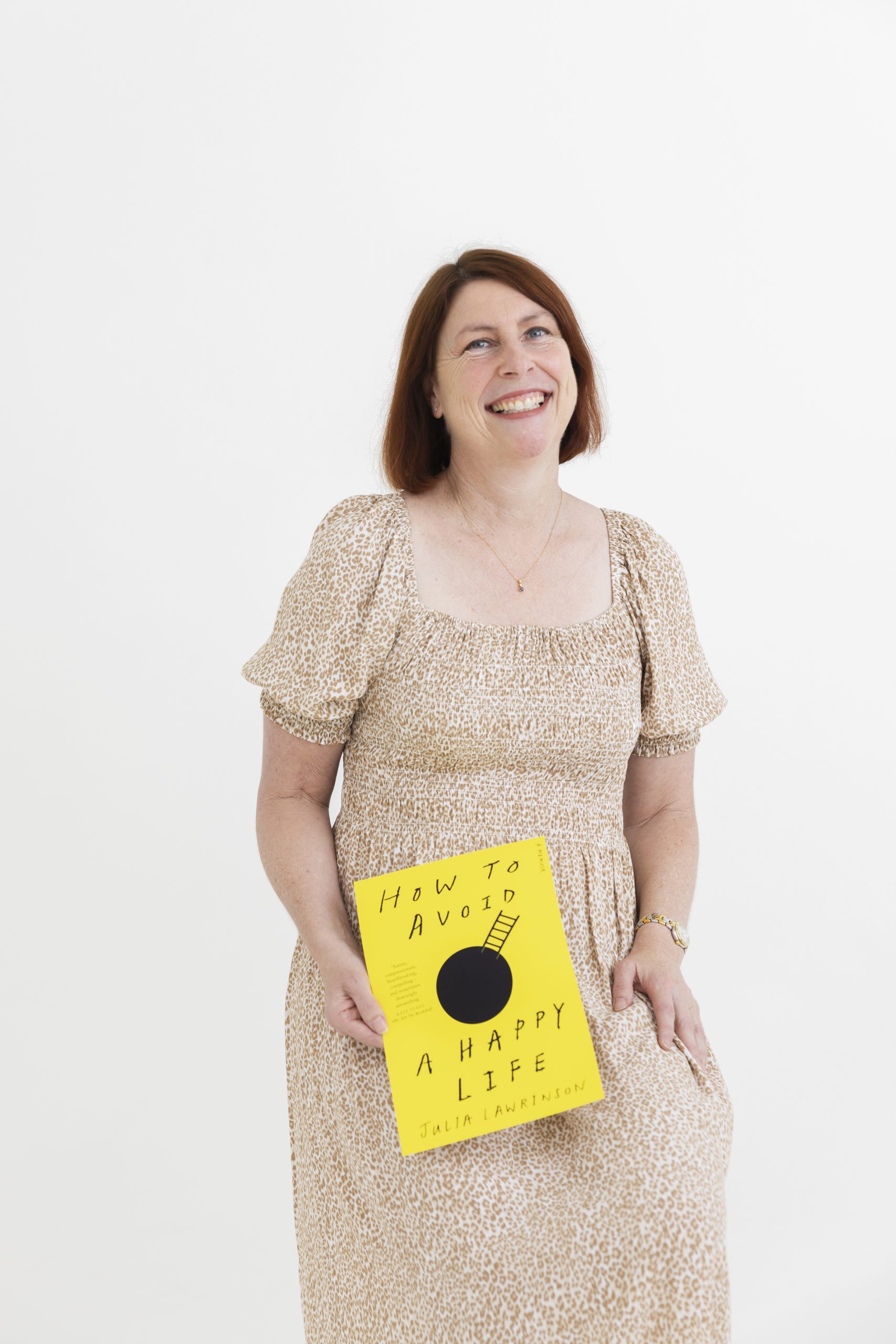
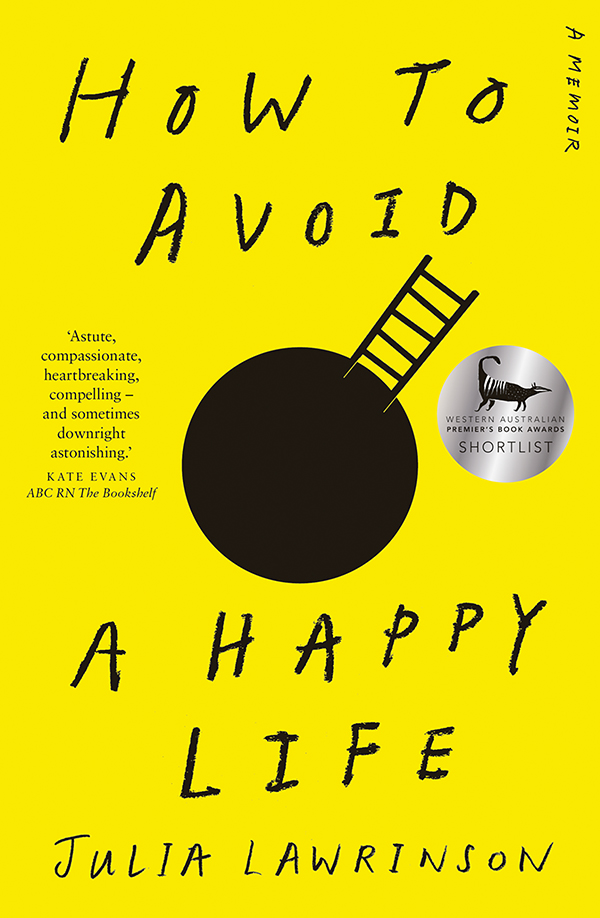
Now, it has all been pinned down in black and white, enclosed in a yellow cover – the colour of optimism.
But.
The events I described in How to Avoid a Happy Life have left their mark on my heart. Representing the people in my life who perplexed me was the challenge of the book – a challenge which I felt was sometimes met, and sometimes impossible.
Firstly, there was my mother – a lively, damaged, irreverent spirit, whose liveliness ended up speaking for herself on the page, defying my fears that I could not approximate her.
Secondly, there was my friend Carita, murdered at 21 in Japan. It was emotionally painful writing about her, but by writing the account of our friendship I felt in the end that I had been able to reclaim something of her.
It was writing about my husband, John – who started out as my former girlfriend’s brother – which was most fraught.
Twelve years older than me, John at first appeared charming and easy going. He did not work, apart from community-based cash-in-hand jobs, despite his showy intelligence. He could not bear feeling obliged; neither could he bear being around physical illness – which became a problem because I developed severe rheumatoid arthritis weeks after our daughter was born. If he felt hemmed in, he raged. To complicate things further, he developed younger onset dementia in his late 40s.
How could I capture the complexity of him, of us in a memoir – in mere words?
My writing mentor for the memoir was Howard Norman, an American writer of exquisite prose who was part coach, part therapist, and part seer. He was perplexed as to why I had engaged him as a mentor when I had a track record as an established novelist.
‘I understand how to write novels,’ I said. ‘I don’t understand how to write this.’
His careful reading of my work in progress and his always gentle questions gave me a direction which I needed. I don’t know if I would ever have finished the book without his perspicacity.
He was able to see the writerly tics I am prone to, and identify when I was skimming over or avoiding a tricky subject, where my reluctance to go into the murk was hindering the work. For example, throughout the draft, I kept summarising information – in part because I didn’t want to load down the prose, but also because going into detail was hard. But he would ask the question, or make the suggestions I needed.
Stay with this a little longer.
A reader will feel more intimately apprised of the nature of your relationship – and that nature in turn will be more enhanced – if you more generously attend to dialogue.
What was it you ‘yelled’? You already have the difficult task of summarizing; let us hear a few choice words, please.
Howard told me that in memoir you use the tools you would as a novelist: character development, narrative arc, suspense, useful description.
For example, I tried to protect our daughter’s privacy by keeping her teenage responses to the disintegration of our household out. Howard, while understanding this, said that she needed more space in the memoir:
I know I must sound like a broken record on this count, but in this fine chapter, again Annie only makes the slightest of cameo appearances. I note on page 29 and 32 she receives a mere sentence or two. I mention this because with such a drama unfolding almost week by week in the foreground, the fact that Annie is very much interwoven into your life is conspicuous by its absence. Remember, Julia, you have already made Annie an important and compelling figure, and so it seems important to keep her so.
In response, I added details of her experiences with John as he was descending into dementia
.In late 2010, John was driving Annie to her best friend’s house, a place he’d visited countless times, when he became gripped by panic.
‘Where do I go?’ he asked her.
‘I don’t know,’ she said. ‘That way?’
‘Which way?’ he said. ‘Tell me which way!’
When Annie told me this, I imagined John peering ahead, the streets rearranging themselves into something unfamiliar, disorienting, like finding yourself on the wrong floor of the building you work in. Everything looks as if it should be familiar, but nothing is where it should be, and where have all your colleagues gone?
Annie pointed John in the right direction, and he said, ‘I knew that, I knew that.’
Howard also reminded me that in memoir, the writing must accommodate or perhaps gesture toward what we cannot know. ‘A memoir is not stenography,’ he said, when I was struggling with lacunae in my diaries, in my memories.
Nevertheless, I felt uncomfortable at the gaps that I could not fill, especially when it came to John. During the writing, I met with his old friends, to verify the stories he’d told me about things he’d done, the claims he’d made about himself. It was only then that I discovered how secretive he had been, how his own accounts were at best incomplete, and often contested by those who’d known him.
There was no way of reckoning with what I found out. He had not been able to recognise me or our daughter for the 10 years before the memoir came out because of the dementia. I could not fact check, sense check. Was I being fair to someone who could not speak for themselves? Had I portrayed, as much as is ever possible, the facets of such a relationship?
Again, Howard prompted me to probe deeper into all facets of the relationship I had with John:
The chapter still basically begs the question, why did you stay in this marriage so long? You do a great deal to answer that. But I wonder if we don’t have enough to go on to understand the nature of the LOVE you had for John – rather than that you simply acquiesced to his nature and to your hope for an ongoing marriage.
I realised I needed to add the happier parts of our life together – the ordinary moments of grace, the things that made me stay:
Each morning I brought John our sweet, milky coffees to his room. I placed his on the bedside table, nudging aside his pile of books. I put mine on the desk in front of the window and drew open the blackout curtains. Through the window we would look out onto the day: the quiet cul-de-sac, the untrimmed grevillea whose heavy, cone-shaped flowers drew honeyeaters with their flecks of yellow brightening their black and tan feathers, the Albany woolly bush. There used to be a lawn at the front, but that had been converted to a garden bed edged with limestone blocks. Corn grew there, then potatoes, then something blighted the patch and it became threaded with weeds. As we’d done on Port Beach when Annie was in day care, we talked about the dreams we’d had, the books we were reading, about Annie.
In the end, I had to make peace with writing about John without having the conclusions I’d wanted, or the resolutions that I could not find in life. It made me able to separate the process of writing a memoir from the process of understanding a life. I had to try to portray him not as he was, as if that were possible, but as how I experienced him. In memoir, as in all writing, we can only strive to understand through the stories we tell each other, and ourselves, in the clearest language available to us.
Julia Lawrinson is a writer and presenter from Western Australia. Since 2001, she has published 17 books for children and young people, many of them award-winning. Her 2024 memoir How to Avoid a Happy Life was shortlisted for both the Western Australian Premier’s Book Award Fellowship and the Premier’s Book Award for Nonfiction. When she is not writing, Julia is a keen adult learner of Indonesian, yoga, and the cello.



Thank you Julia (and Lee) – this is such an incredible and evocative insight to a memoirist’s process and the complexities of grappling with representing life on the page… the curiosity of a character who ‘speaks for themselves’ and the writing mentor who has that innate ability to get at the heart and essence of a story and the storyteller. Amazing! I’m so grateful to you for sharing this, and there are so many facets here that resonate (‘I have reached my hand into the dark maw of existence and divined what its entrails seemed to tell me’). Also, I love finding a new word to add to my writer’s toolkit: perspicacity!
Dear Bianca, I’m so glad you got so much out of Julia’s essay (as did I too!). Thank you for this rich response and I hope your own writing is going very well.